MEPCO Bill Instalments and Due-Date Extension — The Actual Current Rules
If this month’s MEPCO bill is more than you can pay in one go, you can ask for it to be split into instalments, or for the due date to be extended. NEPRA’s Consumer Service Manual allows both. What it does not do — whatever you may have read elsewhere — is guarantee a fixed number of instalments from a named officer.
This page follows the current manual, as revised and circulated by NEPRA on 26 November 2025. Clause 6.8 is shorter than most people expect. If the bill itself is wrong, not just hard to pay, use the bill correction and complaint process first — a plan on a wrong bill locks the wrong amount in place.
What clause 6.8 actually says
Clause 6.8 — “Extension of Due Date for Payment and Installments of Electricity Bills” — has four points:
- No markup on the first instalment, if paid in time. On a request for instalments of the current month’s bill, no markup and no late payment surcharge apply if the first instalment is paid within the due date (6.8.2).
- The rest costs 14% a year. Remaining instalments carry markup at 14% per annum, pro-rata (6.8.2).
- An extended due date carries no late surcharge. Where the due date is extended, late payment surcharge (LPS) is not imposed (6.8.1).
- The facility is discretionary. A company may provide instalments and extensions “as per their business requirements”, and once it allows them, it generates computerized bills for the arrangement (6.8.3, 6.8.4).
LPS is the amount levied when a bill is not paid within its due date. If you neither pay, nor get the date extended, nor agree a plan, a late payment surcharge is added — 5% for the first three days after the due date and 10% after that, charged on the billed amount excluding government taxes and duties, under MEPCO’s tariff terms — and the unpaid amount carries forward as arrears. Clause 6.8’s routes avoid that — but each has to be arranged, not assumed.
What the 14% markup costs on a Rs 30,000 bill
An illustration with round numbers — not a quote; the computerized bill for your plan shows actual figures. Bills often spike because of fuel and quarterly adjustments; the current adjustment rates show what sits on top of the tariff.
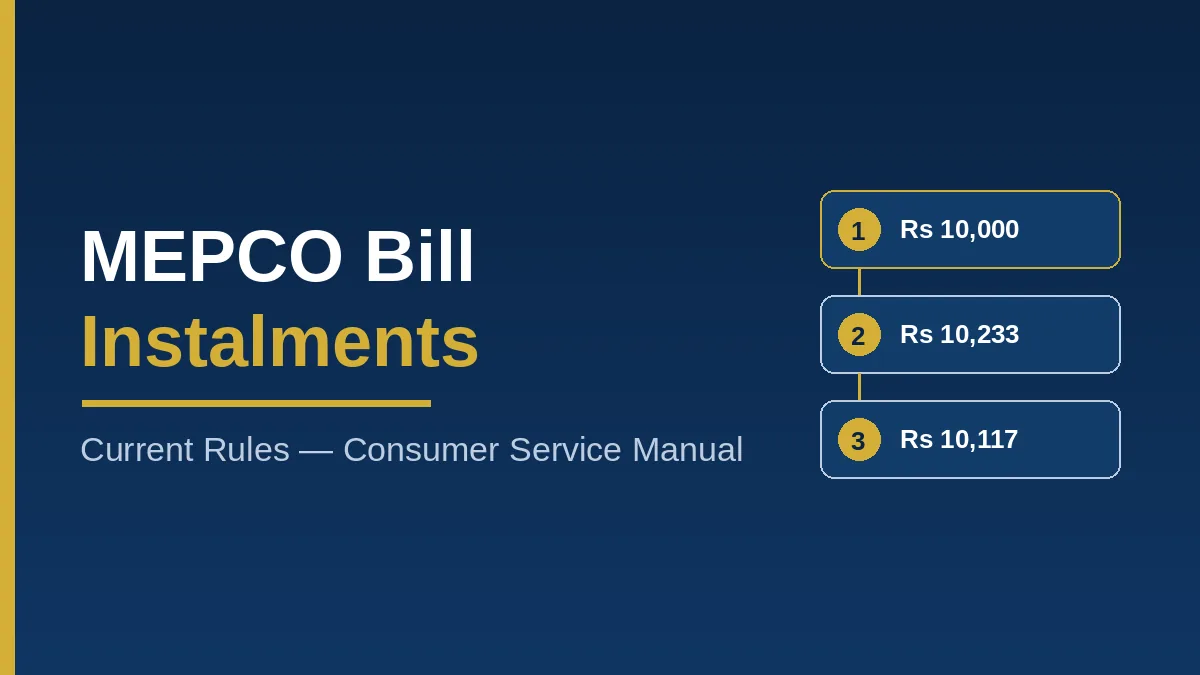
Say a Rs 30,000 bill is split into three monthly instalments of Rs 10,000 principal each. The first, paid within the due date, carries no markup. The second falls due a month later, with Rs 20,000 outstanding: a month’s markup at 14% a year is Rs 233. The third, on Rs 10,000 outstanding, is Rs 117. Total markup: about Rs 350.
| Instalment | Principal | Markup (14% p.a. pro-rata) | Paid |
|---|---|---|---|
| 1st (within due date) | Rs 10,000 | None — clause 6.8.2 | Rs 10,000 |
| 2nd (month 2) | Rs 10,000 | Rs 233 on Rs 20,000 outstanding | Rs 10,233 |
| 3rd (month 3) | Rs 10,000 | Rs 117 on Rs 10,000 outstanding | Rs 10,117 |
Shorter plans cost less, because the balance falls faster. The bill calculator estimates what a normal month should cost from your units.
The approval table you have seen is out of date
Search for MEPCO instalments and you will find the same tidy table on page after page: named officers, from the SDO up to the CEO, each with a rupee limit and a set number of instalments or extension days. It looks official because it once was — the January 2021 edition contained such a table in clause 6.8.
The 2025 revision removed it. The current manual has no officer tier table, no maximum instalment count, no eligibility list, and no “once in twelve months” rule — those specifics were searched for across the full text and are not there. What replaced the table is discretion. A page printing the old table as today’s rule is quoting a manual that no longer governs your bill: any limit an office quotes you now comes from MEPCO’s own practice, not NEPRA’s manual.
How to apply
The manual names no approving officer and prescribes no form. In practice these requests are handled at your local MEPCO subdivision or division office, which decides under its business requirements:
- Act before the due date. Both protections — no markup on a timely first instalment, no LPS on an extended date — depend on the arrangement being in place first. Check the amount and due date on your latest bill.
- Put the request in writing. Say whether you want instalments, an extension, or both, and keep a copy.
- Get the plan on a computerized bill. Clause 6.8.4 requires computerized bills once a plan or extension is allowed. The printed plan is the arrangement; a verbal promise is not.
- Pay the first instalment within the original due date. That payment keeps markup and LPS off it.
- Keep every receipt. If an instalment is later shown as unpaid, the receipt is your evidence.
Billing complaints — which expressly include extension of due date and waiver of LPS — must be redressed within three days (10.3.1(e)), and wrongly applied LPS corrected within three days (10.3.1(d)).
Due-date extension on its own
An extension is the cheapest help available: where the due date is extended, no LPS is imposed at all (6.8.1). The manual sets no maximum number of extension days and names no approving officer.
Two standing rules frame every due date. It must fall within fifteen days of the issue date, and you are entitled to seven clear days from actual delivery of the bill. If the due date falls on a holiday, it moves to the next working day. Where late delivery denies you those seven days, the company’s competent officers can extend the due date without LPS (10.3.1(f)).
The disconnection clock
Chapter 8 sets a sequence for non-payment, driven by time, not by the size of the bill — there is no minimum arrears amount for disconnection.
| Stage | What the manual says |
|---|---|
| Current month unpaid, no other dues | No disconnection for the current month’s bill alone; no cut for one month’s default (8.2.1, 8.2.3) |
| Previous month still unpaid | Seven clear days’ notice is issued with the second month’s bill: pay the dues with that bill or face disconnection (8.2.2) |
| Second bill’s due date passes unpaid | Supply is disconnected; reconnection follows full payment with LPS, or company-allowed instalments (8.2.4) |
| Third bill and two months’ arrears unpaid | An Equipment Removal Order is issued, meter and material are removed, and the connection is marked permanently disconnected (8.2.5) |
If you default on an instalment plan
While instalments are being paid, the connection is protected. Default, and clause 8.2.6 is strict: supply can be disconnected without any further notice, and restored only after at least 50% of the dues are paid. Agree instalments against your real income, not hope.
Reconnection fees
Clause 8.5.3 sets reconnection charges by arrears size, with a condition printed alongside: they apply only where supply has been permanently disconnected and the material actually removed — the Equipment Removal Order stage, not a temporary cut. The dues must also be cleared, in full or in company-allowed instalments.
| Arrears | Reconnection charge |
|---|---|
| Up to Rs 5,000 | Rs 500 |
| Rs 5,001 to Rs 20,000 | Rs 800 |
| Rs 20,001 to Rs 1,00,000 | Rs 2,000 |
| Rs 1,00,001 to Rs 10,00,000 | Rs 4,000 |
| Above Rs 10,00,000 | Rs 10,000 |
Frequently asked questions
Can MEPCO refuse to give me instalments?
Yes. Under clause 6.8.3 the facility is discretionary; there is no enforceable right to a set number of instalments. What the manual fixes are the terms when a plan is granted — no markup or LPS on a timely first instalment, 14% per annum pro-rata on the rest.
How many instalments can I get?
The current manual does not say. There is no count limit and no approval table in the 2025 edition; the table that set those numbers was removed from the January 2021 edition. The number offered is decided by the MEPCO office and printed on the computerized bill for your plan.
Will my electricity be cut while I am paying instalments?
No, provided the instalments are being paid — clause 8.2.6 protects the connection. Miss one, and supply can be disconnected without further notice, restored only after at least 50% of the dues are paid.
My bill arrived late. Can the due date move?
You are entitled to seven clear days from actual delivery, and where late delivery denies you those days, officers can extend the due date without LPS (10.3.1(f)). Raise it promptly — an extension or LPS-waiver complaint must be redressed within three days.